Oral and Explanation Online with some written work and slides
After the preparation of soil, seeds are sown in it.
The process of putting the seeds in the soil is called sowing. While sowing, the following points should be adopted :
1. Always use a good quality, healthy and disease free seeds.
2. Seeds should be sown at the correct depth in the soil. If sown too deep, seed won’t be able to respire. If sown on the surface birds may damage the seeds.
3. Seeds require moisture to germinate, therefore, soil should have adequate water for proper germination of seeds.
4. Seeds should be sown at appropriate distance to prevent overcrowding. This allows plantlets to get enough water, nutrients and sunlight.
In India, a government body called the National Seeds Corporation (NSC) is involved in the production of good quality agricultural seeds. They have seed testing laboratories in different parts of the country.
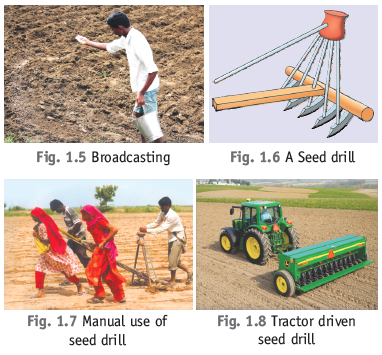
Seeds can be sown by two methods i.e., manually or by seed drills. The process of scattering seeds in field by hand i.e., manually is called broadcasting. Seeds sown by this method are unevenly distributed in the field. For proper spacing and depth, seeds are sown with the help of seed drill.
A seed drill contains funnel shaped opening that leading to long tubes. Seed drill is attached to a plough driven by bullocks or tractor. Seeds are put into the funnel. As the plough makes furrows in the soil, the seeds get placed in the soil by the seed drill. By this practice, seeds also get covered by soil after sowing. This practice
saves the seeds from being eaten by birds.
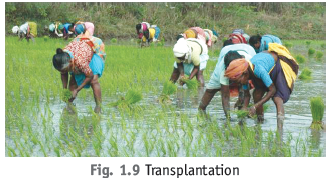
the healthy seedlings and to space them properly while planting. This increases crop production.
Crop plants require nutrients for their growth. They take these nutrients from the soil. When a farmer grows crops continuously in the same field, the soil becomes poor in nutrients. As a result the crop yield gets reduced. Therefore, these nutrients need to be replenished from time to time. This can be done either by natural
methods or by adding manures and fertilizers to the soil. Some natural methods are given below :
1. Leave the field uncultivated for one or more seasons, this allows the soil to naturally regain the nutrients this practice is called field fallow. The decomposition of dead plants and animals by microbes helps in returning the nutrients of soil. However, this practice is not possible due to some economic reasons.
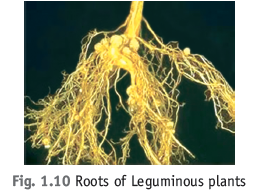
2. Practice crop rotation i.e., change the crop in each season so that soil can maintain its nutrient level for that particular crop. For example, wheat or rice use large amount of nitrogen from the soil. This nitrogen can be naturally replenished if the next crop grown is that of a legume like pea or groundnut. The bacteria called rhizobium are present in the nodules of roots of leguminous plants that can fix nitrogen of air to form nitrates and make the soil fertile for next wheat or rice crop.
3. For the betterment of crops, sometimes two or more crops are grown together in the same field. These crops are selected in such a way that the nutrients need of one crop are fulfilled by the other. This method is called mixed cropping. For example, grams, peas, soyabeans and wheat or rice can be grown together in the same field.
However, these natural methods alone are not enough to maintain fertility of the soil and farmers have to add manures and fertilizers from time to time.
Manures
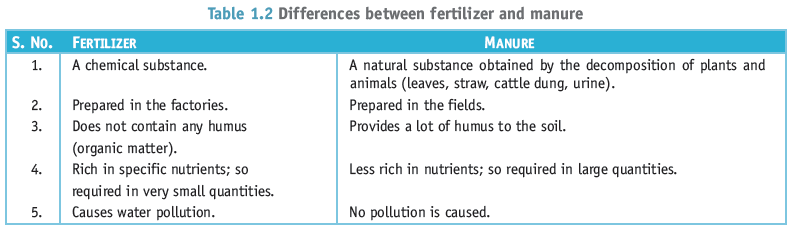
Manure is an organic substance obtained from decomposition of plants and animal wastes. The process of adding manure to the soil is called manuring. Commonly used manures are :
Green manure : It consists of green plants commonly leguminous plants which are ploughed along with the ploughing of soil.
Fertilizers
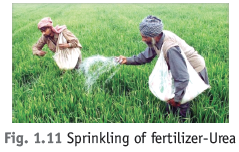
Fertilizers are man-made chemical substances which are rich in a particular nutrient. The most commonly used fertilizers are the NPK fertilizers.
NPK fertilizers supply nitrogen (N), phosphorus (P) and potassium (K) salts to the crops. Fertilizers are easy to store and handle. Since these are soluble in water so readily absorbed by plants. However, if used in excess, these can harm the soil. Fertilizers get washed into water bodies and harm aquatic animals too.
Did all the plants in all the glasses grow at the same pace ? Which glass showed better growth of plants ? In which glass was the growth fastest and healthier ? Obviously your answer will be – glass C because it had the combination of both organic and inorganic nutrients which were the best for fast and healthier growth of plants.
It means supplying water to the crops in the field at specific intervals according to the requirements of the crop cultivated. As you know water is important for the germination of seeds, growth of plants and for the absorption of nutrients from the soil.
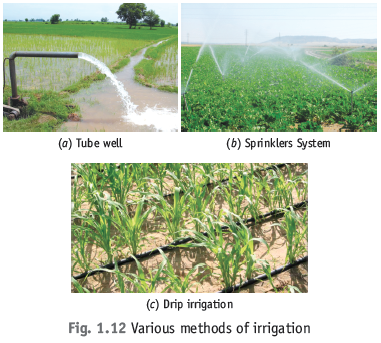
Fields are irrigated with water from the ponds, lakes, canals, wells, tube wells, rivers and dams. The water is supplied to the field by different methods depending upon the regions to be irrigated.
Traditional methods of irrigation like moat, rahat, dhekli etc. were less efficient so many new modern methods of irrigation have come to practice. They are aimed to conserve water and at the same time these methods ensure that water is equally distributed in every part of a field. These methods are :
Sprinkler System : In this method, water flows from the revolving nozzles and is sprinkled on the crops. This system is used for sandy and uneven land.
Drip System : In Drip system, water is allowed to fall drop by drop from a pipe near the roots of plants. Drip system minimizes wastage of water but on the other hand it is an expensive method of irrigation. However, it is useful in those areas where there is water scarcity.
the growth of plants.
Weeding-Removal of weeds
Weeds are the unwanted and uncultivated plants that grow along with the crop plants. Some examples of common weeds are Amaranthus chenopodium, grass, wild oat etc. Weeds compete with the crops for water, nutrients and sunlight. So it is necessary to remove them from the fields.
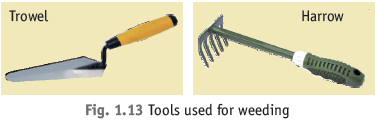
The process of removing weeds from a field is called weeding. It can be done manually or by using a trowel or a harrow. This can also be done by use of chemicals known as weedicides with the help of sprayer or pump. Some common weedicides are dalapon, metachlor and siniazine. These are poisonous and care has to be taken when spraying them. Research for evolving safer methods to kill weeds is going on.
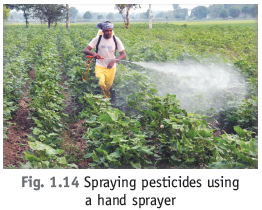
Pests are the organisms that attack and damage crops. They may be rodents or insects. These can be controlled by pesticides. Pesticides which are poisonous chemicals, kill pests but do not affect the growth of plants. Some common pesticides are malathion, gammaxane and disyston.
Plants are also damaged by diseases caused by fungi, bacteria and viruses. These diseases are transmitted through seeds, air, soil and through insects. Some common diseases are :
(i) Rust and smut (fungal diseases of wheat)
(ii) Blight of potatoes (fungal disease)
(iii) Wilt (bacterial disease)
13. What are crumbs?
14. How are crumbs broken down?
15. Why should loose soil be leveled?
- Agricultural practices
- Preparation of soil
Oral and Explanation Online with some written work and slides
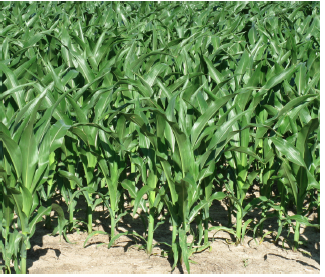
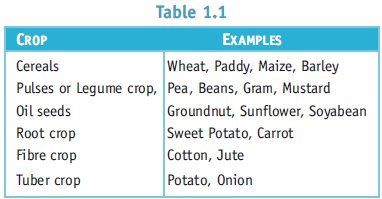
There are two main crops grown in India. These are:
(i) Rabi
(ii) Kharif
Rabi crops : These are grown in the winter season, generally in the months of October to December and harvested by March or April. Therefore, they are also called winter crops. Examples of rabi crops are wheat, barley, gram, mustard and potato.
Kharif crops : These are grown in the beginning of rainy season in the month of June or July and harvested by September or October. These crops are also called summer crops. They require lot of water to grow. Examples of Kharif crops are paddy, maize, soyabean, groundnut, jowar, cotton and pulses.
harvested and stored. The step by step activities are called agricultural practices. Thus, agricultural practices can be defined as the various activities that a farmer performs to produce a good crop.
The basic agricultural practices are :
(i) Preparation of soil
(ii) Selection of good quality seeds and sowing of seeds
(iii) Application of manures and fertilizers
(iv) Irrigation
(v) Weeding
(vi) Protection against pests and diseases
(vii) Harvesting, threshing and winnowing
(viii) Storage
A number of tools are required during the courses of different agricultural practice. These tools are called implements. Common implements used in agriculture are :
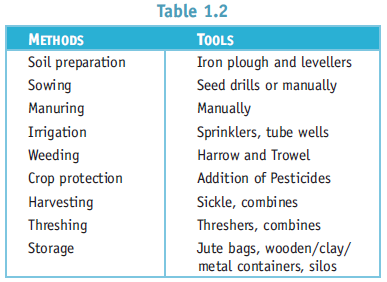
Plants are grown in soil. They obtain water and nutrients from the soil through their roots. Soil anchors the roots of plants. Soil provides microbes and other organisms such as earthworms help to increase soil fertility. It is, therefore, important that the soil is well prepared.
Preparation of soil requires two steps :
(i) Ploughing or tilling
(ii) Levelling
Ploughing : The process of loosening and turning of the soil is called ploughing or tilling. This has the following advantages :
1. Loose soil contains a lot of air spaces in it. This allows roots to breathe easily.
2. Loose soil also allows the roots to penetrate deep into the soil. Thus, the plant gets fixed to the soil firmly.
3. Ploughing uproots the undesirable plants (weeds) and kills them.
4. Loose soil mixes uniformly with manure and fertilizers.
5. Loose soil allows the growth of earthworms and microbes present there. Earthworms help to turn and loosen the soil. Earthworms and microbes help in adding humus (dead organic matter) to the soil. These organisms are, therefore, called the friends of the farmer.
6. Ploughing brings the nutrient-rich soil from the lower layers to the top and makes it easily available for plants to use.
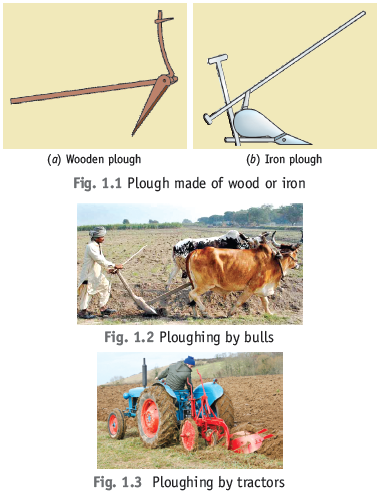
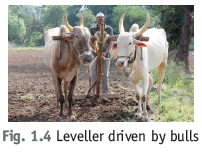
Levelling : The field after ploughing may still have big pieces of soil called crumbs. It is necessary to break these crumbs with a plank. The field is levelled with the help of a leveller before sowing of seeds.
(b) manuring
(c) tilling
(d) irrigation
ii. Weeds are the:
(a) main crop plants
(b) insects and pests
(c) unwanted plants growing along the crop
(d) chemical substances
iii. Combines are used for:
(a) sowing of seeds
(b) harvesting the crops
(c) threshing
(d) harvesting and threshing both.
iv. Separating grains from chaff is called:
(a) winnowing
(b) threshing
(c) fallow
(d) harvesting.
v. Weedicides are used to destroy:
(a) insects
(b) weeds
(c) pests
(d) none of these.
~Role of microbes in our life
Oral and Explanation Online with some written work and slides.
- Protozoa
- Bacteria
- Fungi
- Algae
Introduction
Microorganisms
- Microorganisms are microscopic organisms that cannot be seen with the naked eye.
- These organisms are usually unicellular in nature.
- There are four major types of microorganisms:

Bacteria: These are single-celled organisms with a rigid cell wall. They can only be seen under a microscope which enlarges images from 100 to 1000 times.

| Shape of Bacteria | Example | Image |
| Comma-shaped Bacteria | Fig 3: Vibrio Cholera | Vibrio Cholerae |
| Spherical-shaped Bacteria (Cocci) |
Fig 3: Streptococcus | Staphylococcus and Streptococcus |
| Rod-shaped Bacteria (Bacilli) |
Fig 4: Salmonella | E.coli and Salmonella |
| Spiral-shaped Bacteria (Spirilla) |
Fig 5: Borrelia | Treponema |


- Fungi: These are non-green plants and hence, cannot make their own food. They either live as parasites (deriving nutrition from host organisms, for example, Puccinia which causes wheat leaf rust) or grow on the organic matter (such as bread mould).

Fig 6: Puccinia triticina

Fig 7: Bread Mould
Fungi, like mushrooms, moulds, mildews, and years, are eukaryotic. It means that they have a true nucleus.
The main components of fungi are:
i. Hyphae: They are thread-like filaments which penetrate into substrates, secrete enzymes to break down nutrients into smaller molecules, and absorb them.
ii. Spores are a unit of sexual or asexual reproduction. They can adapt for dispersal and survival for extended periods of time in unfavourable conditions.
Algae : These are simple plant- like organisms which are usually aquatic in nature. They contain a cell wall and chlorophyll and can make their own food by photosynthesis.Algae can be unicellular or multicellular. Some of the common examples are diatoms, Chlamydomonas, and seaweed.
Protozoa: Protozoa are unicellular are organisms. Some of them live independently while others live as parasites. Many of the parasitic protozoans cause diseases in plants, domestic animals, and human beings. Example of some protozoans are Amoeba, Plasmodium and Paramecium

Fig 8: Paramecium
How are Viruses different from other microbes?
Viruses are microscopic organisms but they are different from other microbes because they reproduce only inside the cells of the host organism (which can be a plant, animal, or a bacterium).

Fig 09: Types of Viruses
Viruses are much smaller than bacteria and come in a wide variety of shapes and sizes. A complete virus particle is known as Virion.
Virion consists of a nucleic acid surrounded by 'capsid'. Capsid is a protective coat made of protein. The subunits of this protein called 'Capsomeres'. Viruses can be seen only by an electron microscope as they are ultramicroscopic in size.
Outside the body of a living organism, they do not show any reaction and hence, can be crystallized and stored like non-living things.
Where do Microorganisms Live?
Microbes can survive in all kinds of environments – from icy cold climates to hot springs (any kind of temperature); and deserts to marshy lands (any humidity level). Some live independently while others live as parasites – inside the bodies of other organisms (including animals and human beings).
Microorganisms and Us
Some microorganisms are beneficial to us while others are harmful and cause diseases.

How are bacteria useful to us?
Bacteria are helpful because:
It decomposes organic wastes (such as vegetable peels, animal remains, and faeces etc.).
It is used in the preparation of medicines.
It increases soil fertility by fixing nitrogen.
It is used in the setting of curd and making cheese, pickles, and other food items.
How is yeast useful to us?
It is used in the commercial production of alcohol and wine which is done by growing yeast on natural sugars present in fruit juices and grains like rice, wheat, and barley.
What are Antibiotics? What are their uses?
Antibiotics are medicines that can kill or stop the growth of disease-causing microorganisms.
For Example, Penicillin.
 Antibiotics are used to:
Cure a variety of diseases (such as streptomycin, erythromycin, and tetracycline that are made from bacteria and fungi),
Cure microbial infection in animals (by mixing antibiotics with the feed of livestock and poultry), and
Control several plant diseases.
What precautions should be followed while taking antibiotics and why?
Antibiotics should be taken only on the advice of the doctor, and one must complete the course the doctor prescribes.
Antibiotics taken in wrong doses may make the body resistant to the drug and it may not be effective in the future. Moreover, antibiotics may also kill the beneficial bacteria in the body.
Please Note: Antibiotics cannot cure cold and flu caused by viruses.
Vaccines


Oral and Explanation Online with some written work and slides.
Combustion
- A chemical process in which a substance reacts with oxygen to give off heat and light is called combustion.
- The burning of wood is an example of combustion.
Combustible and Non-Combustible Substances
- Substances which easily catch fire are combustible substances, such as paper, coal, wood.
- Substances which do not catch fire readily are non-combustible substances, such as sand, water, glass.
Fuel
- Any substance, which upon combustion produces a usable amount of energy is known as fuel. For example, fossil fuels, biogas, nuclear energy, etc.
- Fuels can be solid, liquid or gas depending on their state.
- On the basis of their occurrence, it can be either natural or artificial.
Ignition Temperature
The lowest temperature at which a combustible substance catches fire when heated in air is called its ignition temperature.
Inflammable Substances
The substances, which have very low ignition temperature and can easily catch fire with a flame are known as inflammable substances. Examples: diesel, LPG, acetone.
Fire
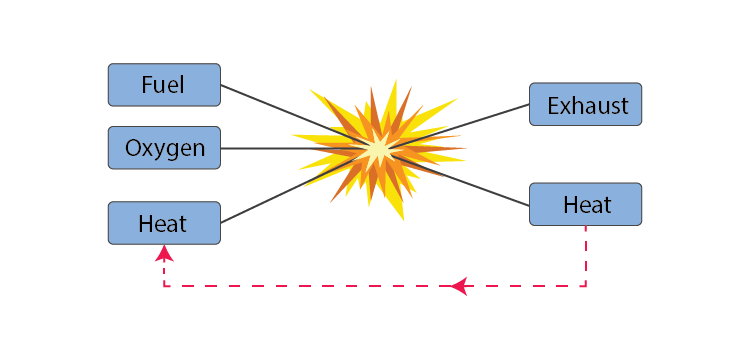
- Fire is the result of a chemical combustion reaction between oxygen and some sort of fuel.
- How long a fire lasts depends on how much fuel and oxygen are available.
Candle Flame
Fire Triangle
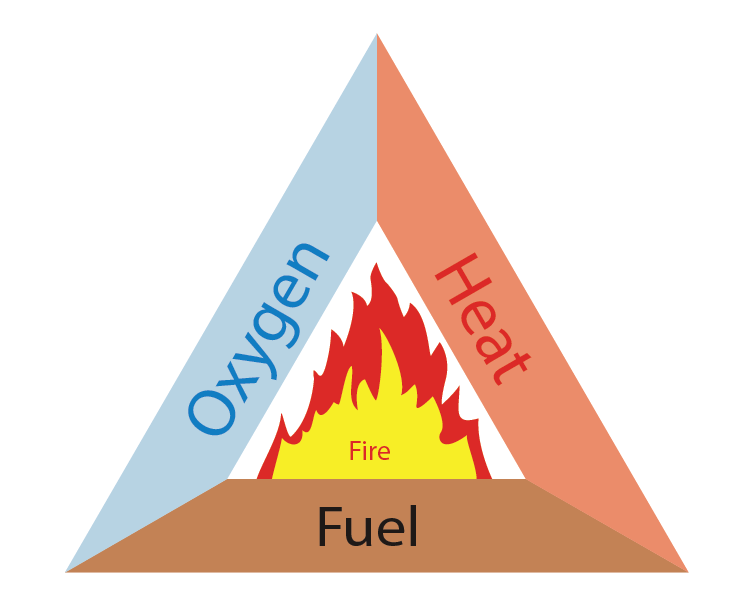
For the generation of fire, we need three things to be present simultaneously:-
- Some sort of fuel or combustible material.
- A heat source to raise the temperature of the fuel to its ignition temperature.
- Enough oxygen to sustain combustion. So, if we remove any one of these resources, the fire can be controlled.
Flame
- Flame is the visible and gaseous part of the fire.
- What we see as the flame is the light energy released due to the combustion of fuel.
Zones of Candle Flame
Structure of Flame
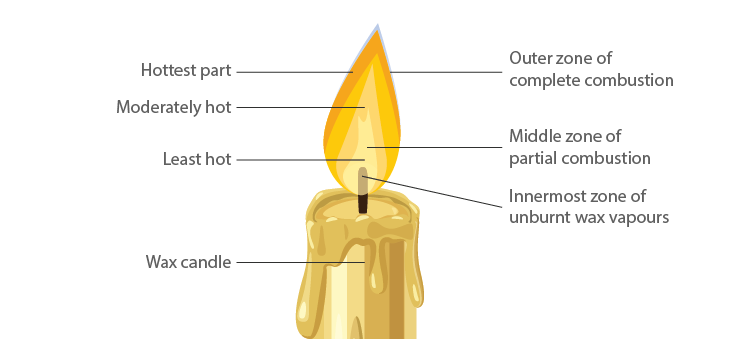
- The outermost zone is the hottest among all zones and is blue in colour and this is due to complete combustion. It is the non-luminous part of the flame.
- The middle zone of the candle flame is moderately hot and is yellow in colour, and partial combustion of fuel takes place. It is the bright part of the flame.
- The innermost zone of the flame is the least hot and is black in colour. This is due to the presence of unburnt wax vapours.
Petroleum:-It is dark brownish to green coloured viscous liquid fossil fuel. It has strong foul smell due to the presence of sulphur containing compounds in it. It is commonly called as crude oil. The economy of a nation depends to a great extent on petroleum wealth, that's why petroleum is called the black gold. Its name is derived from Latin words Petra (meaning rock) and O1eum (meaning oil). Thus, petroleum literally means "rock oil".
Origin of Petroleum: Petroleum is a complex mixture of solid, liquid and seous hydrocarbons, mixed with salt water and earthy particles. It is always found trapped between two impervious rocks.
It is believed that petroleum is formed by the anaerobic decomposition of extremely small sea animals and plants which got buried in the sea bed millions of years ago. Let us see how this happened.

Fractional distillation is the separation of a mixture into its component parts, or fractions. Chemical compounds are separated by heating them to a temperature at which one or more fractions of the mixture will vaporize. It uses distillation to fractionate.

Oral and Explanation Online with some written work and slides.


Oral and Explanation Online with some written work and slides.
(i) In humans sound is produced because of vibration of his voice box or x.
(ii) It is situated at the upper end of windpipe. There are two stretched membranes called vocal cords attached in larynx with a narrow slit between them for passes air.

Voice Box in Humans
(i) The travelling of sound is called propagation of sound.
(ii) Sound is propagated by the to and fro motion of particles of the medium.
(i) A medium is necessary for the propagation of sound waves.
(ii) The matter or substance through which sound is transmitted is called a medium. The medium can be solid, liquid or gas.
(iii) Sound cannot travel in vacuum. A true vacuum refers to the complete absence of matter. Sound wave can travel only through matter. So, sound needs a physical medium in order to propagate anywhere.
(iv) We hear sound which comes to us through air medium particles.
(v)Aquatic animals communicate as sound travels through water.
(ii) The vibrations are amplified by the three bones of the middle ear called hammer, anvil and stirrup. The middle ear then transmits the sound wave to the inner ear.
(iii) In the inner ear the sound wave converted into electrical signals by cochlea and send to the brain through the auditory nerves. The brain interprets the signals as sound. That is how we hear.

(i) Sound is produced by to and fro motion of an object is known as vibration. This motion is also called oscillatory motion.
(ii) Sound propagates from one place to another in the form of waves, i.e. because of the disturbance of particles of the medium.
(iii) Wave is a phenomenon or disturbance in which energy is transferred from one point to another without any direct contact between the points. So, sound is considered as a wave.
(i) In a sound wave, the maximum displacement associated with the particle constituting a wave is called its amplitude.

(i) The number of vibrations and osscillations completed by an object in one second is the frequency of the sound.
(ii) Frequency = Number of Oscillation/ Total time
ⱱ = 1/T
(iv) A frequency of 20 Hz is twenty oscillation per second.
(v) If an object oscillates or vibrates 80 times in 1 second, then its frequency will be equal to 80 hertz.

(i) The time taken by object or the particle of the medium for completing one oscillation or vibration is called the time period.
(ii) It is represented by ‘T’. SI unit is Second.
(iii) Time period = Time/ Numbers of oscillation or vibration.

(ii) Loudness or softness of a sound depends upon its amplitude.
(iii) Loudness of sound is proportional to the square of the amplitude of the vibration producing the sound.
Loudness α (Amplitude)2
If the amplitude becomes twice, the loudness increases by a factor of 4.

| Normal breathing | 10 dB |
| Soft whisper (at 5m) | 30dB |
| Normal conversation | 60dB |
| Busy traffic | 70dB |
| Average factory | 80dB |
(ii) The pitch of sound (Shrillness or flatness) depends on the frequency of vibration.
(iii) Sound with greater frequency is shriller and has higher pitch. Sound with lower frequency is less shrill and of lower pitch.

(ii) Sound of frequency below 20 hertz and above 20,000 hertz is called sound of inaudible range. Humans cannot hear the sound of inaudible range.
(iii) Many animals, such as dogs, cats, etc. can hear the sound with frequency above 20,000 hertz.
Noise and Music:
1. Noise: It is the sound that is unpleasant to hear. (E.g., Sound produced by vehicles)
2. Music: It is the sound that is pleasant to hear. (E.g., Sound coming out of musical instruments)
(i) Presence of excessive, loud, unwanted or unbearable sound to our ears sounds in the environment is called noise pollution.
(ii) Examples: sounds of vehicles, explosions including bursting of crackers, machines, loudspeakers, television with high volume, loudspeakers etc
(i) Due to noise pollution many types of health related problems occurs, such as lack of sleep (insomnia), hypertension (High blood pressure), loss of hearing, anxiety, etc. Sound above 80 dB is very painful to hear.
(ii) A person who is exposed to loud sound continuously may get permanent or temporary impairment of hearing or loss of hearing.
Noise can be limited or controlled by controlling the noise source. Noise pollution can be controlled by taking following steps:
(i) TV, radio or loudspeakers should be played at low volume.
(ii) By installing high quality silencing devices in vehicles, air craft engines, industrial machines and home appliances.
(iii) We should not use loud vehicle horns.
(iv) Noise producing industries should be set up away from residential areas.
(v) Trees absorb sound. So plantation of trees should be done along the road sides and around buildings
(vi) Awareness campaign and noisy operations should be done to make people aware about the harmful effects of noise pollution and measures to control noise pollution.
(i) Sound is a form of energy like heat energy, light energy, potential energy and kinetic energy. It causes a sensation of hearing in our ears.
(ii) Sound helps us communicate with each other.
Production of Sound:
(i) Sound is produced due to the vibration of object.
(ii) The motion of materials or objects causes vibration.
(iii) Vibration is a kind of rapid to and fro motion of an object a central position. It is also referred to as oscillation.
Examples:
(a) A stretched rubber band when plucked vibrates and produces sound.
(b) In the music room of your school you hear the sounds made by musical instruments like flute, tabla, harmonium, guitar etc. because of vibration.
(c) When a spoon is beaten on the plate, it starts vibrating and produces sound.
(i) In humans sound is produced because of vibration of his voice box or larynx.
(ii) It is situated at the upper end of windpipe. There are two stretched membranes called vocal cords attached in larynx with a narrow slit between them for passes air.
(iii) Muscles attached to the vocal cords can make the cords tight or loose. When the vocal cords are tight and thin, produce different type or quality of voice.
(i) The travelling of sound is called propagation of sound.
(ii) Sound is propagated by the to and fro motion of particles of the medium.
Sound needs a medium to propagate:
(i) A medium is necessary for the propagation of sound waves.
(ii) The matter or substance through which sound is transmitted is called a medium. The medium can be solid, liquid or gas.
(iii) Sound cannot travel in vacuum. A true vacuum refers to the complete absence of matter. Sound wave can travel only through matter. So, sound needs a physical medium in order to propagate anywhere.
(iv) We hear sound which comes to us through air medium particles.
(v)Aquatic animals communicate as sound travels through water.
(i) The funnel shaped outer ear collects the sound. The sound wave passes through the ear canal to thin and stretched membrane called eardrum or tympanum. The ear drum vibrates and produces vibrations.
(ii) The vibrations are amplified by the three bones of the middle ear called hammer, anvil and stirrup. The middle ear then transmits the sound wave to the inner ear.
(iii) In the inner ear the sound wave converted into electrical signals by cochlea and send to the brain through the auditory nerves. The brain interprets the signals as sound. That is how we hear.
(i) Sound is produced by to and fro motion of an object is known as vibration. This motion is also called oscillatory motion.
(ii) Sound propagates from one place to another in the form of waves, i.e. because of the disturbance of particles of the medium.
(iii) Wave is a phenomenon or disturbance in which energy is transferred from one point to another without any direct contact between the points. So, sound is considered as a wave.
1. Amplitude:
(i) In a sound wave, the maximum displacement associated with the particle constituting a wave is called its amplitude.
(ii) It is represented by ‘A’. SI unit is metre.
(i) The number of vibrations and osscillations completed by an object in one second is the frequency of the sound.
(ii) Frequency = Number of Oscillation/ Total time
(iii) Frequency is expressed in hertz. It is represented by Hz.
(iv) A frequency of 20 Hz is twenty oscillation per second.
(v) If an object oscillates or vibrates 80 times in 1 second, then its frequency will be equal to 80 hertz.
From above figure waves have same amplitude but number of vibrations in one second are different. So their frequencies are different.
3. Time period:
(i) The time taken by object or the particle of the medium for completing one oscillation or vibration is called the time period.
(ii) It is represented by ‘T’. SI unit is Second.
(iii) Time period = Time/ Numbers of oscillation or vibration.
1. Loudness:
(i) Loudness of sound is the measure of sound energy reaching the ear per second.
(ii) Loudness or softness of a sound depends upon its amplitude.
(iii) Loudness of sound is proportional to the square of the amplitude of the vibration producing the sound.
Loudness α (Amplitude)2
If the amplitude becomes twice, the loudness increases by a factor of 4.
(iv) Loudness of sound is measured in decibel (dB).
The following table gives different types loudness of sound coming from various sources.
(i) Pitch is the sensation (Brain interpretation) of the frequency of an emitted sound.
(ii) The pitch of sound (Shrillness or flatness) depends on the frequency of vibration.
(iii) Sound with greater frequency is shriller and has higher pitch. Sound with lower frequency is less shrill and of lower pitch.
(i) Children and women produce high frequency sound so their sound is shriller or higher pitch. On the other hand, an adult male produces lower frequency sound so his sound is less shrill or lower pitch.
(ii) A drum produces lower frequency sound which is less shrill or lower pitch, while a whistle produces higher frequency sound which is shriller or higher pitch.
(i) Sounds of frequency range between 20 Hz to 20,000 Hz are called audible sound. The human beings can hear the sound range between 20 hertz to 20,000 hertz.
(ii) Sound of frequency below 20 hertz and above 20,000 hertz is called sound of inaudible range. Humans cannot hear the sound of inaudible range.
(iii) Many animals, such as dogs, cats, etc. can hear the sound with frequency above 20,000 hertz.
1. Noise: It is the sound that is unpleasant to hear. (E.g., Sound produced by vehicles)
2. Music: It is the sound that is pleasant to hear. (E.g., Sound coming out of musical instruments)
Noise Pollution:
(i) Presence of excessive, loud, unwanted or unbearable sound to our ears sounds in the environment is called noise pollution.
(ii) Examples: sounds of vehicles, explosions including bursting of crackers, machines, loudspeakers, television with high volume, loudspeakers etc
Problems due to Noise Pollution:
(i) Due to noise pollution many types of health related problems occurs, such as lack of sleep (insomnia), hypertension (High blood pressure), loss of hearing, anxiety, etc. Sound above 80 dB is very painful to hear.
(ii) A person who is exposed to loud sound continuously may get permanent or temporary impairment of hearing or loss of hearing.
Measures to Limit Noise Pollution:
Noise can be limited or controlled by controlling the noise source. Noise pollution can be controlled by taking following steps:
(i) TV, radio or loudspeakers should be played at low volume.
(ii) By installing high quality silencing devices in vehicles, air craft engines, industrial machines and home appliances.
(iii) We should not use loud vehicle horns.
(iv) Noise producing industries should be set up away from residential areas.
(v) Trees absorb sound. So plantation of trees should be done along the road sides and around buildings
(vi) Awareness campaign and noisy operations should be done to make people aware about the harmful effects of noise pollution and measures to control noise pollution.


- The progress of civilization is linked to the discovery of many metals and non-metals
- Metals were discovered only around 5000 years ago.
- Non-Metals were discovered much later
- Carbon and Sulfur are earliest non metals known to man.
- Even our history is classified corresponding to periods related to discovery of Metals like Stone age,Bronze age , Iron age
- The wealth of a country is determined by the by the amount of gold in its reserve
1. Metals:
Those materials which possess the characteristic of being hard, shiny, malleable, fusible, ductile, etc. are termed as metal. Few examples of metals are iron, gold, silver, aluminium, copper, etc.
(a) Malleability:
It is that property of metals which allows them to be beaten into the thin sheets.

(b) Conductivity:
It is that property of metals which allows the current and heat to pass through them easily.
Example- Metals like iron rod, nail, copper wire, etc. are good conductors of electricity.
(c) Ductility:
It is that property of metals which allows them to be drawn into the wires.
It is that property of metals which produces ringing sounds on hitting.

It is that property of metals which makes them shine and their structures are capable of reflecting incident light.

2. Non -Metals:
Those materials which do not possess the characteristics of metals are termed as non-metal. Materials like coal and sulphur are soft and dull in appearance. They break down into powdery mass on tapping with hammer. They are non-sonorous and are poor conductors of heat and electricity. Few examples of non metals are sulphur, carbon, oxygen etc.
Chemical Properties of Metals & Non-Metals:
1. Reaction with Oxygen
(a) For Metals:
Generally, when metals are reacted with oxygen they will form metallic oxides. And these metallic oxides are basic in nature.
Example- 1: Rusting of Iron. Following is the reaction to express it.
Iron (Fe) + Oxygen (O2) + Water (H2O) → Iron Oxide (Fe2O3) Example- 2: If a copper vessel is left open in presence of the moist air, then, a dull green coating will be observed on it. The green material is a mixture of copper hydroxide (Cu(OH)2) and copper carbonate (CuCO3). Following is the reaction to express it:
2Cu + H2O + CO2 + O2→Cu (OH)2 + CuCO3
Testing of nature of Rusting:
(i) Collect a spoonful of rust and dissolve it in a very little amount of water.
(ii) The rust remains suspended in water. Shake the suspension well.
(iii) Test the solution with red and blue litmus papers. The red litmus turns blue.
So, generally metallic oxides are basic in nature.

(b) For Non-metals:
Generally, non-metals also produce oxides when reacted with oxygen. But, in contrast to metals, these oxides are acidic in nature.
Testing the nature of non metal:
(i) Take a small amount of powdered sulphur in a deflagrating spoon and then heat it.
(ii) As soon as sulphur starts burning, introduce the spoon into a gas jar/ glass tumbler.
(iii) Cover the tumbler with a lid to ensure that the gas produced does not escape.

(iv) After some time remove the spoon. Add a small quantity of water into the tumbler and quickly replace the lid. Shake the tumbler well. Check the solution with red and blue litmus papers.

Testing of Solution with Litmus paper
(v) The name of the product formed in the reaction of sulphur and oxygen is sulphur dioxide gas. When sulphur dioxide is dissolved in water sulphurous acid is formed. Following is the reaction to express it:
Sulphur dioxide (SO2) + Water (H2O) → Sulphurous acid (H2SO3)
(vi) The sulphurous acid turns blue litmus paper red.
Generally, oxides of non-metals are acidic in nature.
2. Reaction with Water:
(a) For Metals:
Some metals react vigorously with water like in case of sodium. It is stored in kerosene.. While, some metals reacts very slowly with water like in case of iron.

Reaction of Sodium with Water
(b) For Non-metals:
Generally, most non-metals do not react with water but there are some non-metals which are quite reactive in air like phosphorous, which is very reactive and is kept in water to prevent explosion.
3. Reaction with Acids:
(a) For Metals:
Generally, a metal reacts with acids and releases hydrogen gas with a ‘pop’ sound.
The presence of hydrogen gas is confirmed by bringing a burning matchstick or candle near the gas. And when the burning matchstick or candle produces pop sound then it means that hydrogen gas has evoloved.
It is found that, copper does not reacts with hydrochloric acid while it reacts with a sulphuric acid.
(b) For Non-metals:
Generally, non-metals do not react with acids.
4. Reaction with Bases:
(a) For Metals:
Generally, reactions of metals with bases releases hydrogen gas, like in case of many metals they react with sodium hydroxide to produce hydrogen gas.
(b) For Non-metals:
Generally, reactions of non-metals with bases are complex.
5. Displacement Reaction:
During reaction if a metal replaces another metal from its compound then such reactions are called displacement reaction.
Metals can actually be arranged as per their reactivity order, thus, a more reactive metal will always displace a less reactive metal from its compound but a less reactive one cannot replace a more reactive metal.


Example : When zinc is reacted with copper sulphate solution, then copper will be displaced by zinc as zinc is more reactive than copper. The blue colour of copper sulphate disappears and a powdery red mass of copper is deposited at the bottom of the beaker. The reaction-
Copper Sulphate (CuSO4) + Zinc (Zn) → Zinc Sulphate (ZnSO4) + Copper (Cu)
Applications of Metals:
(i) Metals are generally used in making of machines, automobiles, airplanes, cars, satellites, etc.
(ii) Some metals are used in making wires like copper, etc.
(iii) Some metals are used for making ornaments like gold, silver, etc.
Applications of Non - Metals:
(i) The oxygen necessary for all living beings to survive is a non-metal.
(ii) Some non-metals are used as fertilizers to enhance the growth of plants.
(iii) Some non-metals are used for water-purification.
(iv) Some non-metals are used as antiseptic.
(v) Non-metals used in crackers.


Oral and Explanation Online with some written work and slides.
Comparison of plant and animal cell
Part of the Cell | Plant Cell | Animal Cell |
Shape of the cell | Quadrangular or hexagonal | Round |
Cell wall | Distinct Cell Wall and protective in function | Absent |
Nucleus | Present | Present |
Nuclear membrane | Present | Present |
Cytoplasm | Present | Present |
Plastids | Help plants to synthesize and store their food | Absent |
Vacuole | Mostly one and big in size | Many and smaller in size |
Cell Membrane | Present | Present |
Lysosomes | Absent or scanty | Many |
Cilia and flagella | Absent | Present |
Centrioles | Absent | Present required for cell division |


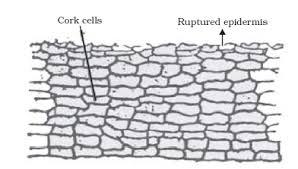
Plants and plant parts also need protection from external factors. So, there are certain tissues that perform this action. Let us learn about them.
It includes epidermis and cork (or phellem).
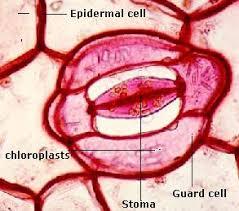
Epidermis of a leaf has small pores, called stomata. Each stoma is bounded by specialized epidermal cells called guard cells. These Guard cells are the epidermal cells only and contain chloroplasts. The stoma allows gaseous exchange to occur during photosynthesis and respiration.
Complex permanent tissues
You all know that green plants can carry out photosynthesis and also absorb water through roots. But it may make you curious to know that how these substances are transported to whole plant. As we know, they don’t have blood, lymph or so. It is due to this complex tissue that water is transported and food is translocated. Let us learn about it.
They consist of more than one type of cells.
They are of the following two types:
- Xylem
- Phloem
Xylem and phloem are popularly known as vascular tissues
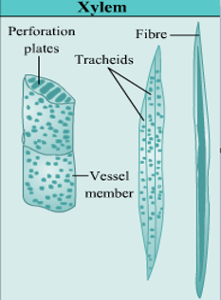
Xylem
Xylem is composed of cells with four different parts:
- Tracheids
- Vessels
- Xylem parenchyma
- Xylem sclerenchyma.
Except xylem parenchyma, all other xylem elements are dead and bounded by thick lignified walls. Vessels are shorter and wider than tracheid. Vessels are very long tube-like structures. Tracheids are elongated cells with tapering ends. They also conduct water. Since, tracheids do not have open ends like vessel, so the water has to pass from cell to cell via the pits.
Functions
- The main function of xylem is to carry water and mineral salts upward from the root to different parts of shoots.
- Since walls of tracheids vessels and sclerenchyma of xylem are lignified they give mechanical strength to the plant body.
Phloem
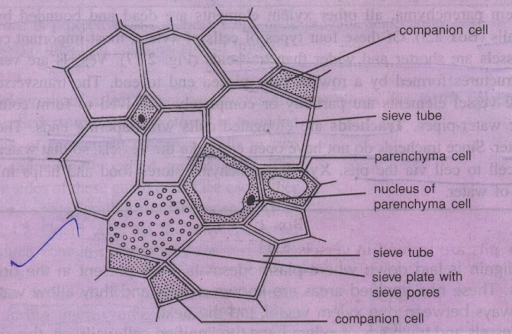
It consists of four components:
- Sieve tubes
- Companion cells
- Phloem parenchyma
- Phloem fibres.
Sieve tubes
Sieve tubes are slenderical tube –like structures composed of elongated thin-walled cells, placed end to end. Their end walls are perforated by numerous pores and are called sieve plates.
They are small thin-walled cells containing dense and very active cytoplasm and large elongated nucleus.
Functions
Photo-synthetically prepared food materials are transported from the leaves to the storage organs.
This tissue forms the outer layer of all body parts. It is protective in nature as it acts a barrier to keep different organs separate. It is present almost everywhere like in skin, lining of buccal cavity, blood vessels, etc.
The cells of this tissue are tightly packed and form a continuous sheet. Cells of epithelium contain very little or no intercellular matrix. Epithelial cells lie on a delicate non-cellular basement membrane which contains a special form of matrix that contains a protein called collagen.
Functions
- These cells protect the underlying cells.
- Epithelial cells form the lining of the mouth and alimentary canal and protect these organs.
- It helps in absorption of water and nutrients.
- It helps in elimination of waste products.
- It also acts as a secretor.
We have 600 muscles in our body and they are contractile in nature. They help in bringing about movements in body parts. Like it helps us to move, it helps our heart to beat, it helps in bringing about all movements through our limbs.
On the basis of their location, structure and functions there are following three types of muscle fibres:
- Striated muscles
- Smooth muscles
- Cardiac muscles.
(Also called as Striped, skeletal or voluntary muscles)
It is seen in muscles of limbs, body wall, neck, etc. Striated muscles are present in tongue, pharynx, diaphragm and upper part of the esophagus. They are called visceral striated muscles.
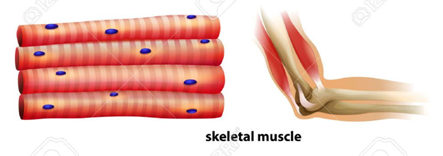
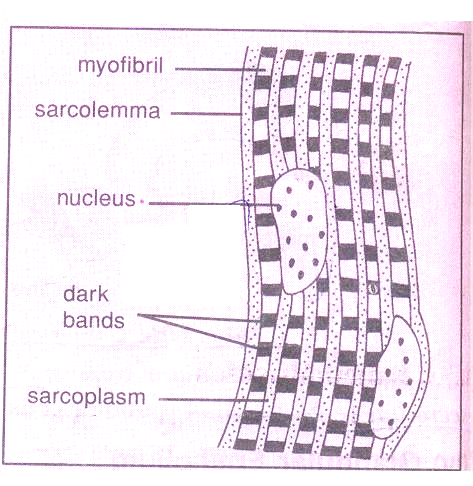
- The entire muscle fibres show alternate dark and light stripes. They are called striped muscles.
- They are attached to bones and are responsible for body movements they are called skeletal muscles.
- These muscles work according to our will. They are also called voluntary muscles.
- They are long or elongated with non-tapering ends.
Functions
- Striated muscles are powerful and undergo rapid contraction. These muscles can be tired and need rest.
- Striated muscles provide the force for locomotion and all other voluntary movements of the body.
Smooth Muscles
They are seen in the walls of the hollow (tubular) visceral organs except that of the heart that is why they are called visceral muscles.
- There is a single centrally located cigar-shaped nucleus in the centre of cytoplasm or sarcoplasm.
- These fibrils do not bear any bands , stripes or striations across the muscle hence, called smooth or unstrained muscles.
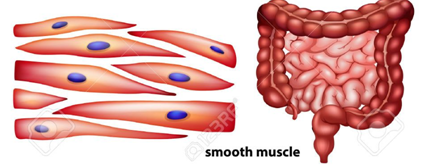
- Smooth muscles do not work and contract according to our will. So they are also called involuntary muscles. The movement of food in the alimentary canal, opening and closing of tubes are involuntary movements.
- Smooth muscles contract slowly but can remain contracted for a long period of time.
Cardiac Muscles
As you all know that we have an important organ that is heart and it keeps on pumping blood to all body parts without getting tired. It is because of a special muscle in it that is cardiac muscle.
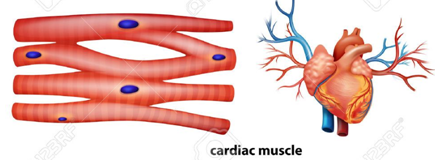
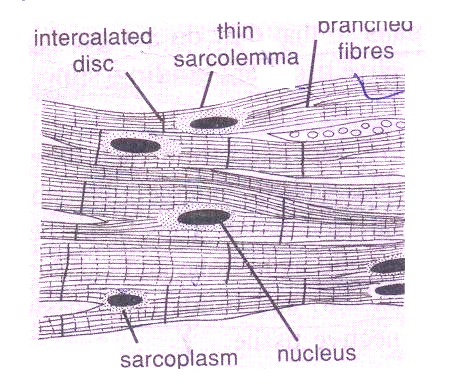
These muscles show the characteristics of both smooth and striated muscles. Cardiac muscles are composed of branched fibres, the branches join to form a network. Each fibre or cell is surrounded by sarcolemma and has cytoplasm (sarcoplasm) with longitudinal myofibrils and a centrally located nucleus. Cardiac muscles have stripes or light and dark bands. They show densely stained cross-bands called Intercalated discs.
- Cardiac muscles contract and relax rapidly.
- The contraction and relaxation of the heart muscles help to pump and distribute blood to various parts of the body.
The connective tissue is specialized to connect and anchor various body organs. It binds the tissue and gives support to various parts of the body by forming packing around organs so that they do not get displaced by body movements. They act as binding, supporting and packing tissue.
Its cells are living and separated from each other and are few in number. They have homogeneous gel-like intercellular substance called medium or matrix which forms the main bulk of the connective tissue. Thus, the space between cells is filled with the non-living matrix which may be solid like in bones and cartilages and fluids as in the blood. Matrix is fibrous in nature and binds other tissues in fact the nature of matrix decides the function of connective tissue.
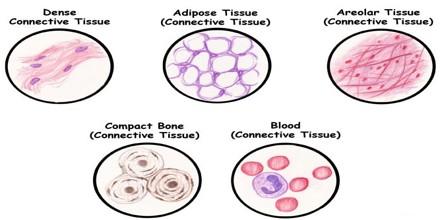
Types of connective tissue
In animals there are of following five types as given below:
- Areolar (loose) connective tissue
- Dense regular connective tissue
- Adipose tissue
- Skeletal tissue
- Fluid connective tissue
Nervous tissue
This tissue helps us in thinking, listening, conveying messages, etc. On the whole, we can say that it helps in control and coordination in the body.
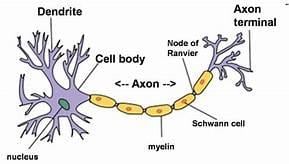
It is a specialized tissue that helps in transmitting messages within our body. It contains highly specialized cells called neurons. The neurons have the ability to receive stimuli from within or outside the body and to conduct impulses to different parts.
Each neuron consists of:
- Cyton
- Dendrite
- Axon
The irregular structure called cell body encloses a nucleus in neuroplasm.
From cell body, small branches arise on upper side called dendrite. On the lower side, it gives out only one branch that is elongated called axon. The whole neuron is made up of neurolemma. It has a fatty layer on it as a modulated sheath that creates nodes of ranvier that help in saltatory conduction. Axon ends into nerve endings.
Function of neuron
It is to form nerves that further helps in control and coordination of body .
- A)Choose the correct option:-Question 1.Nucleus is separated from cytoplasm by(a) nuclear membrane(b) nucleoplasm(c) organs(d) cell membraneQuestion 2.The liquid material in the nucleus is(a) chromosomes(b) bacteria(c) nucleoplasm(d) nucleolusQuestion 3.Tissues combine to form(a) nucleus(b) cells(c) organism(d) organsQuestion 4.Cells present in living organism differ in(a) numbers(b) shape(c) size(d) all of theseQuestion 5.Cells which lack nuclear membrane are(a) eukaryotic cells(b) prokaryotic cells(c) single cells(d) multicellsQuestion 6.The control centre of all the activities of a cell is(a) nucleus(b) nucleoplasm(c) cytoplasm(d) organellesQuestion 7.The coloured organelles which are found in plants only are(a) chlorophyll(b) plastids(c) vacuoles(d) WBCQuestion 8.Genes are located in(a) chrpmosomes(b) plastids(c) cytoplasm(d) lysosomeQuestion 9.A group of similar cells combine to form(a) tissue(b) organ(c) organisms(d) organellesQuestion 10.The organism containing only a single cell is called(a) unicellular organism(b) multicellular organism(c) organelle(d) all of theseQuestion 11.Cell walls is found in(a) plant cells only(b) animal cells only(c) both (a) and (b)(d) none of themQuestion 12.The empty blank looking structures in the cytoplasm is(a) vacuoles(b) plastids(c) plasma membrane(d) nucleusQuestion 13.The other name of cell membrane is(a) plasma membrane(b) cell wall(c) nuclear membrane(d) none of theseQuestion 14.The basic structural and functional unit of all living organism is(a) cell(b) cell wall(c) cell membrane(d) chloroplastsQuestion 15.Chromosomes are found in(a) nucleus(b) nucleolus(c) nucleoplast(d) vacuole


~Introduction
~Cropping pattern
~Types of crops.
a) Rabi crops b) Kharif crops
• Agricultural practices
EXPLAINED
1. Introduction of crops.
2. What are the cropping pattern in India?
3. What are the different types of crops?
4.How agricultural practices have done?
MAIN TEACHING
Oral and Explanation Online with some written work and slides
1. Define crops.
2. Discuss the types of crops.
3. Cropping pattern in India.
STUDENTS TAKE AWAY:
1. What are crops?
2. What are the types of crops?
MAIN TEACHING
Oral and Explanation Online with some written work and slides
1. Define crops.
2. Discuss the types of crops.
3. Cropping pattern in India.
STUDENTS TAKE AWAY:
1. What are crops?
2. What are the types of crops?
ASSIGNMENTS:-
1. Choose the correct options:
i. Watering the crops is called:
(a) sowing
(b) manuring
(c) tilling
(d) irrigation
ii. Weeds are the:
(a) main crop plants
(b) insects and pests
(c) unwanted plants growing along the crop
(d) chemical substances
iii. Combines are used for:
(a) sowing of seeds
(b) harvesting the crops
(c) threshing
(d) harvesting and threshing both.
iv. Separating grains from chaff is called:
(a) winnowing
(b) threshing
(c) fallow
(d) harvesting.
v. Weedicides are used to destroy:
(a) insects
(b) weeds
(c) pests
(d) none of these.
